Travel404 vs. Cloudbeds
One is a large hotel platform that added dorm beds. The other is built from the bed up. Here is where each one actually wins.
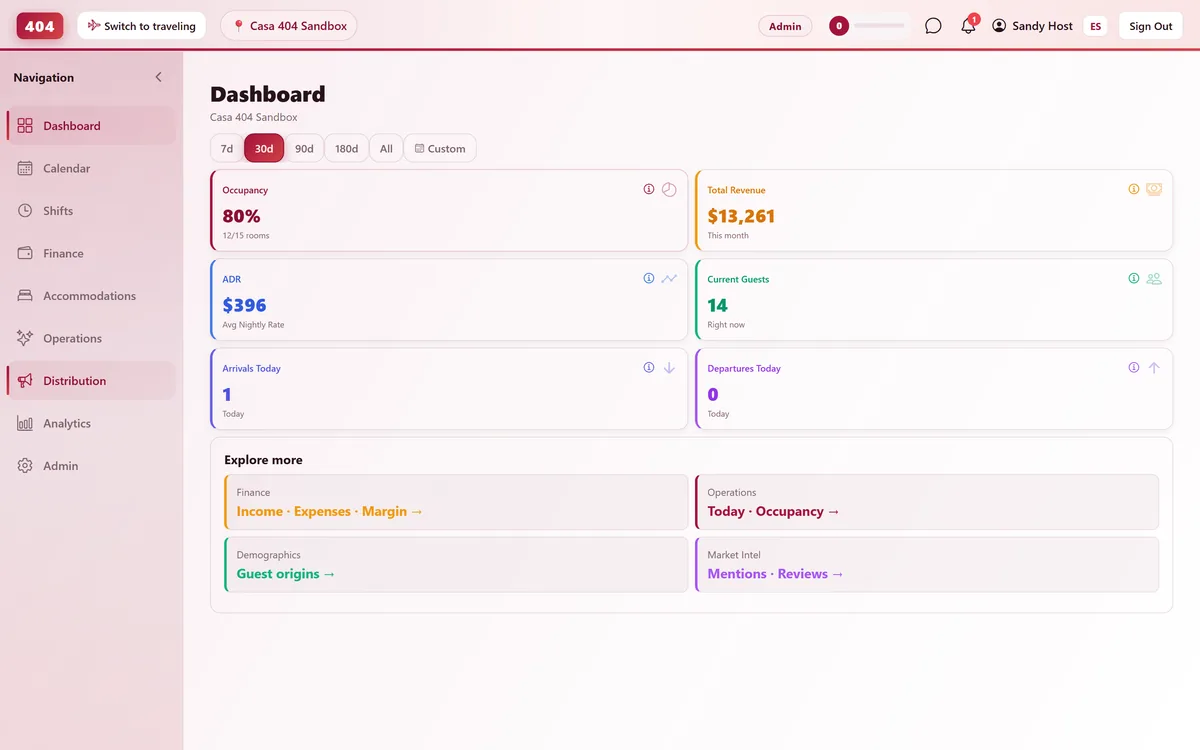
Cloudbeds is a real platform — 20,000+ properties in 150+ countries, a 450+ integration marketplace, and an AI revenue engine called Signals. It also prices per room behind a sales call, and it is built first for hotels, with hostels as one segment among many. Travel404 does one thing: hostels and coliving spaces where dorm beds outnumber private rooms and the guest community is the actual product. No hand-waving below — where Cloudbeds is the better tool, we say so.
| Feature | Travel404 | Cloudbeds |
|---|---|---|
| Published pricing you can see without a sales call | Yes | No |
| Priced by guest capacity, not just room count | Yes | Partial |
| Native dorm & mixed-room inventory | Yes | Yes |
| Commission-free direct booking engine | Yes | Yes |
| Channel manager reach | Yes | Yes |
| Guest community app — who’s staying, activities, events | Yes | No |
| Month-to-month billing, no negotiated contract | Yes | No |
| Free trial with no card required | Yes | No |
| Built hostel-first, not hotel-first | Yes | No |
What each one costs
Travel404
Published on the site, no sales call. Essentials runs $35–$115/month, Pro $58–$190, Complete $100–$330 — the band is set by guest spots (private rooms × 2 + dorm beds), from 1 up to 100. A 14-day free trial needs no card. Past 100 guest spots, it becomes a custom Enterprise quote. Billed monthly in USD; switch plans or cancel any month.
Cloudbeds
Not published. Cloudbeds quotes each property across four tiers — Flex, One, Experience, Enterprise — based on room count, modules and card-processing volume. Third-party pricing roundups report real-world costs of roughly $180/month for a small property on Flex, up to $320+/month on Experience, with hostel dorm beds typically priced at about a third of a private room’s rate.
If you run a hostel under about 100 beds, the gap is concrete: our top Complete band — every feature we build — tops out at $330/month, no card-volume tiers, no call required to see the number.
-
Built for beds, not retrofitted for them
Cloudbeds is a hotel platform that added dorm support, and the pricing logic shows it — rooms first, with a fractional bed rate layered on top. Travel404 was built the other direction: a private room is 2 guest spots, a dorm bed is 1, from the first line of the pricing ladder. If your inventory leans private and hotel-like, that difference matters less. If half your beds are dorms, it is the whole model.
-
The guest community app — nobody else has this
Cloudbeds, like every hotel-first PMS, stops at the booking. Travel404 goes further: guests see who else is staying, join activities posted once in the app, and connect before they even arrive. That social layer is the actual reason hostels exist, and it is missing from Cloudbeds and every competitor we know of. If your hostel runs on communal energy, this is not a nice-to-have — it is the product.
-
Where Cloudbeds wins
Cloudbeds has more than a decade in the market, 20,000+ properties, and a 450+ integration marketplace we do not have. Its Signals AI engine forecasts against data from that whole portfolio — a scale advantage a younger platform cannot match yet. If you run a hotel chain, a portfolio past 100 rooms, or need deep accounting and POS integrations beyond what ships natively, Cloudbeds is the more proven choice.
-
Contracts and the sales call
Cloudbeds pricing lives behind a quote — you talk to sales, and terms including cancellation and early-termination charges sit in an individual agreement, not a public page. Travel404’s price is on this site: pick your capacity, see the number, start a 14-day trial with no card, and change plans or cancel in any given month. For a small operator, that transparency is worth something on its own.
Which one should you choose
Travel404
Choose Travel404 if you run a hostel or coliving space, dorms and mixed rooms are a real part of your inventory, and you want a published price, a same-day setup, and the only guest community app on the market.
Cloudbeds
Choose Cloudbeds if you are running a hotel or a multi-property portfolio past 100 rooms, need enterprise-scale revenue management and a large integration marketplace, and would rather have an account manager negotiate your price than read it off a page.
Common questions
Does Cloudbeds actually handle dorm beds and mixed rooms?
Yes. Cloudbeds supports dorm inventory, lets you mark beds male / female / mixed, and can sell a dorm bed as a private room when it makes sense. It is a real hostel feature — built on top of a room model designed for hotels first.
Is Cloudbeds more expensive than Travel404 for a small hostel?
Usually, yes. Cloudbeds does not publish prices, but third-party pricing roundups put its entry Flex plan around $180/month, scaling with room count and card volume. Travel404’s Complete plan tops out at $330/month even at 91–100 guest spots, and starts at $35/month on Essentials for a small property.
Does Cloudbeds lock you into a long contract?
Terms are set per customer and Cloudbeds does not publish them, but its published terms state that unlawfully ending a contract early means paying out the charges for the rest of the term. Travel404 bills monthly in USD and you can switch plans or cancel in any given month.
Which one reaches more OTAs?
Both are strong. Cloudbeds connects 450+ channels, built over more than a decade. Travel404 connects 200+ through Channex, including regional and niche channels. For the mainstream ones — Booking.com, Hostelworld, Expedia, Airbnb — both get the job done.
When should I actually pick Cloudbeds over Travel404?
If you are running a hotel chain, a portfolio past 100 rooms, or need enterprise revenue management plus a large integration marketplace, Cloudbeds is the more proven platform — 20,000+ properties and more than a decade behind it. Travel404 is built for one thing: hostels and coliving spaces that live and die by community, not just room count.
See it running in your hostel
Set up in 30 minutes. No credit card required.