Travel404 vs Mangobeds: built by a former customer
Co404 ran three hostels on Mangobeds for over a year before building Travel404. Here's the honest, feature-by-feature comparison — including where Mangobeds still wins.
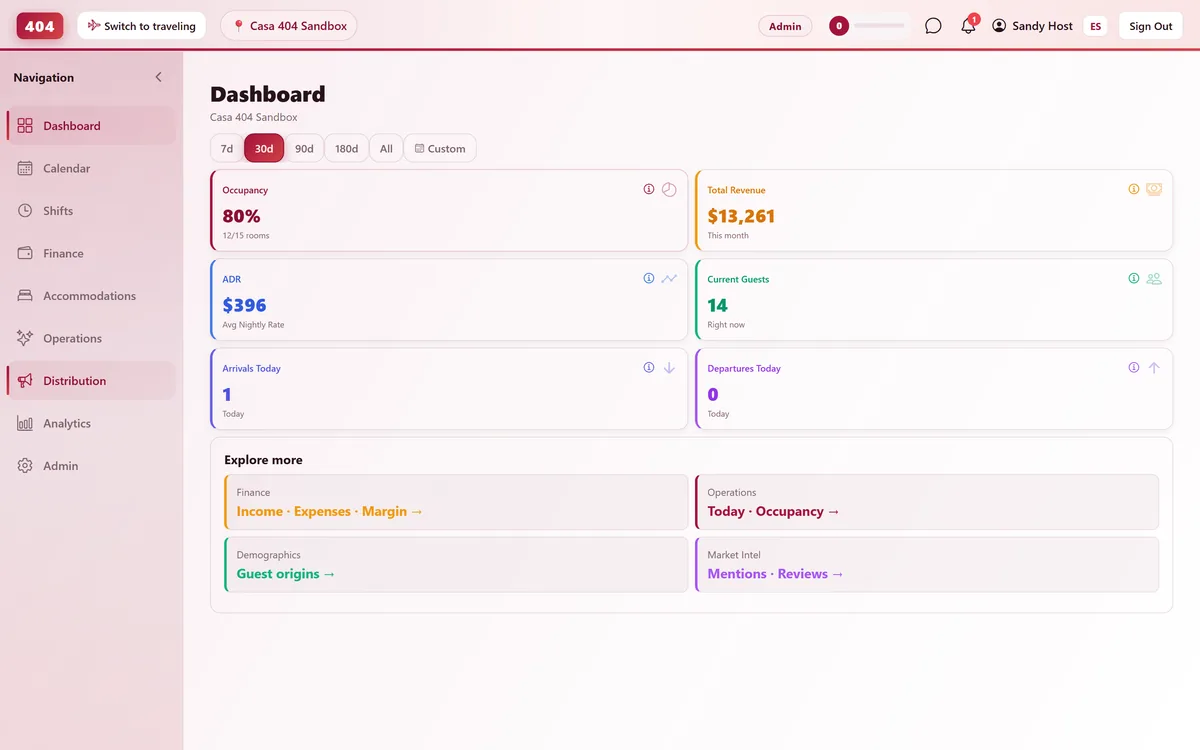
Mangobeds is a capable, broad hospitality platform. Travel404 does one thing: it's the PMS built specifically for hostel and coliving operators, including the guest community layer that got us to build it in the first place. Below is a plain feature-by-feature comparison, pricing included.
| Feature | Travel404 | Mangobeds |
|---|---|---|
| Bed-level dorm & private-room inventory | Yes | Yes |
| Per-room, per-bed and flat pricing modes | Yes | Partial |
| Drag-and-drop tape-chart calendar | Yes | Partial |
| Channel manager (OTA sync) | Yes | Yes |
| Direct booking engine, zero commission | Yes | Yes |
| Built-in POS for bar & extras | Yes | No |
| Automatic invoicing | Yes | Yes |
| Housekeeping task management | Yes | No |
| Staff shift scheduling, incl. volunteers | Yes | Partial |
| 30+ granular staff permissions | Yes | No |
| Guest community app (activities, who's staying) | Yes | No |
| AI assistant that answers questions about your own numbers | Yes | No |
What each one costs
Travel404
Banded by guest spots (private rooms count 2, dorm beds count 1) — Essentials $35–$115/mo, Pro $58–$190/mo, Complete $100–$330/mo for 1–100 spots, billed in USD. A flat $500/mo Ultimate plan for hands-on strategy help. Operators over 100 spots get a custom quote. 14-day free trial, no card required.
Mangobeds
Banded by number of rooms/units: Basic from about US$29/mo, Pro from about US$49/mo (their 'most popular' tier), Premium from about US$79/mo — 2 months free on annual billing and unlimited properties on every plan. They publish in pesos (MXN 495 / 835 / 1,344); converted at 16.97 to the dollar on 12 September 2026.
Both scale with property size but on different axes — Travel404 by total guest capacity (rooms × 2 + dorm beds), Mangobeds by room/unit count. Compare using your own bed count, not sticker price alone.
-
We ran Co404 on Mangobeds for over a year
Before building Travel404, our founder ran three coliving and hostel properties in Mexico and Colombia on Mangobeds. It handled bookings, channels and payments well enough — Mangobeds still publishes a case study from that time. What it couldn't give us was a way to turn guests into a community before they even checked in. That gap is the entire reason Travel404 exists.
-
We only build for two kinds of property
Hostels and coliving spaces, and nothing else. That is why a dorm bed is a first-class thing here rather than a room with a number after it, why a stay can be re-priced when a guest extends into their third week, and why volunteers are a role instead of a workaround. Platforms that also serve glamping sites and RV stopovers carry that generality into every screen you use. If you run a mixed portfolio, look at one of them instead — we would rather be the obvious choice for one kind of operator than an option for everyone.
-
The guest community app — our reason for existing
Guests on Travel404 see who else is staying, join activities posted once instead of scrawled on a whiteboard, and see who else is in the house. None of that is in Mangobeds' feature list. It's not a nice-to-have widget — it's why dorms turn into groups of friends, why activity tours fill up, and why guests leave better reviews.
-
One connected platform vs. one big toolbox
PMS, channel manager, booking engine, payments, operations and the community app are one product, one login, one source of truth. A bed moved on the calendar is already right in the folio, in the report and on Booking.com — there is no connector in between to configure, to pay for, or to watch break at midnight. The trade is real: if your operation depends on a specific outside tool, check that we reach it before you switch.
Which one should you choose
Travel404
Choose Travel404 if you run a hostel or coliving space and want the guest community app, bed-level pricing built in from day one, and one team working across PMS, channel manager, booking engine and community — with zero commission on direct bookings.
Mangobeds
Choose Mangobeds if you manage a mix of property types beyond hostels — villas, campsites, glamping — want a guest-facing AI agent out of the box, or need deep no-code integrations via Zapier, Make or n8n.
Common questions
Did Travel404 actually use Mangobeds?
Yes. Co404's three hostels and coliving properties in Mexico and Colombia ran on Mangobeds for over a year — Mangobeds still lists Co404 as a customer case study. We left to build the guest community features we couldn't get anywhere else, then built the rest of the platform around it.
Can I move from Mangobeds to Travel404 without losing my bookings?
Yes — your room types, rates and current reservations come across during onboarding, and OTA connections get relinked through Channex so nothing goes stale on Booking.com or Hostelworld mid-move. Book a demo and we'll walk through your specific property.
Does Travel404 charge a commission on bookings, like an OTA?
No. Both Travel404's booking engine and Mangobeds' let guests book direct with zero commission — the difference is what's built around that booking afterwards.
I run villas and campsites, not just a hostel. Which fits better?
Mangobeds — it covers glamping, tiny houses, villas, campsites and RV stopovers alongside hostels. Travel404 is intentionally narrower: hostels and coliving spaces, built bed-first.
Does Travel404 have an AI chatbot for guest questions?
Not a guest-facing chatbot — Mangobeds' AI Agents cover that. Travel404's AI lives in Reports, reading your occupancy and revenue data to flag what needs attention, not answering guest messages.
See it running in your hostel
Set up in 30 minutes. No credit card required.